How Warfront works
Game manual · Updated 30 October 2026
What is Warfront?
Warfront is a turn-based strategy game about the Second World War in Europe. The map shows the world as it was in August 1939 – Germany with Austria and Bohemia, Poland reaching to Lwów and Wilno, Romania with Bessarabia, Italy with Albania and colonies in Africa. You pick one European nation and lead it month by month until May 1945: you train troops, build factories, forts and air wings, plan offensives and decide when to declare war or make peace.
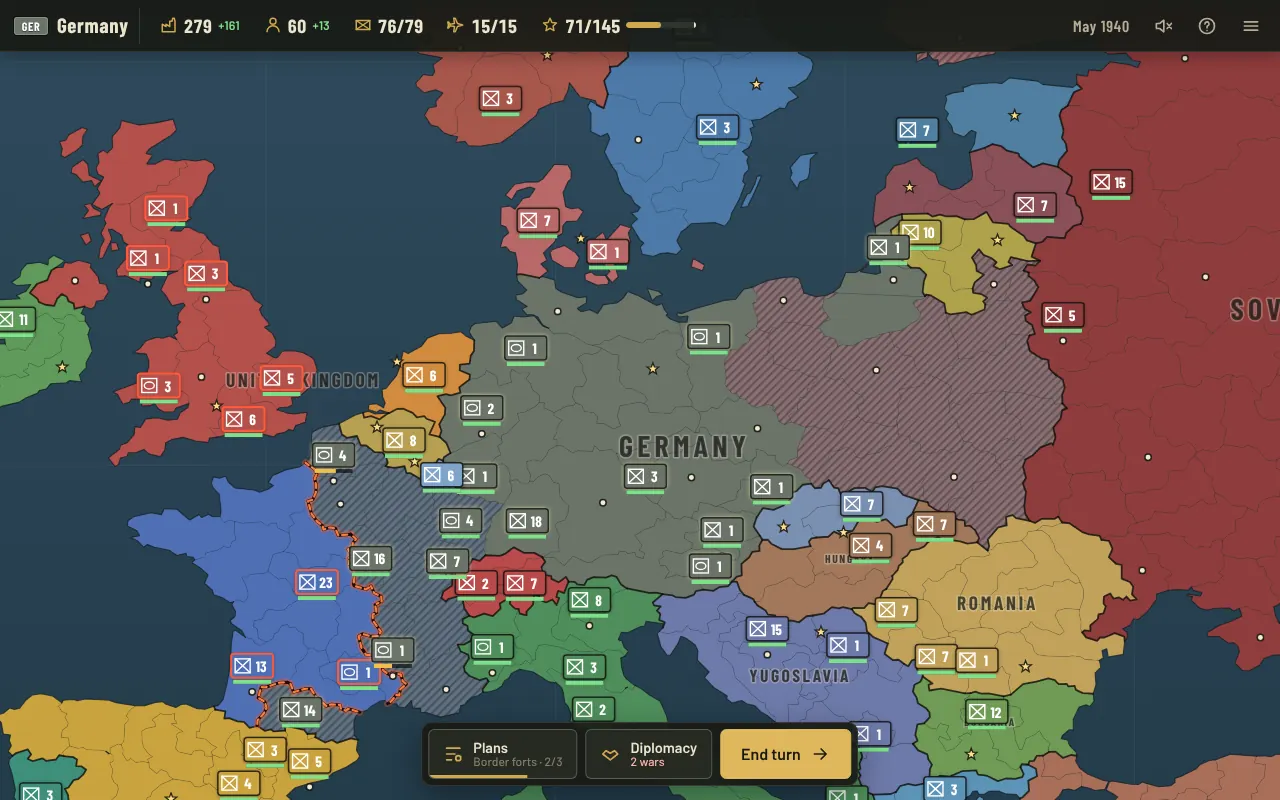
Warfront is made for beginners. There is only one kind of money, three kinds of units and a handful of clear rules, and the game shows you the odds before every battle. It runs right in your browser on a computer, tablet or phone – no download, no account. Your game is saved automatically after every turn.
Getting started
Click New game and choose a nation from the list or straight on the map. The great powers – France, Germany, Italy, the Soviet Union and the United Kingdom – are the easiest to start with. Small nations like Poland, Belgium or the Netherlands are a real challenge. Then pick a difficulty: on Easy the computer builds less and attacks more carefully, on Hard it builds faster and attacks more often.
Controls
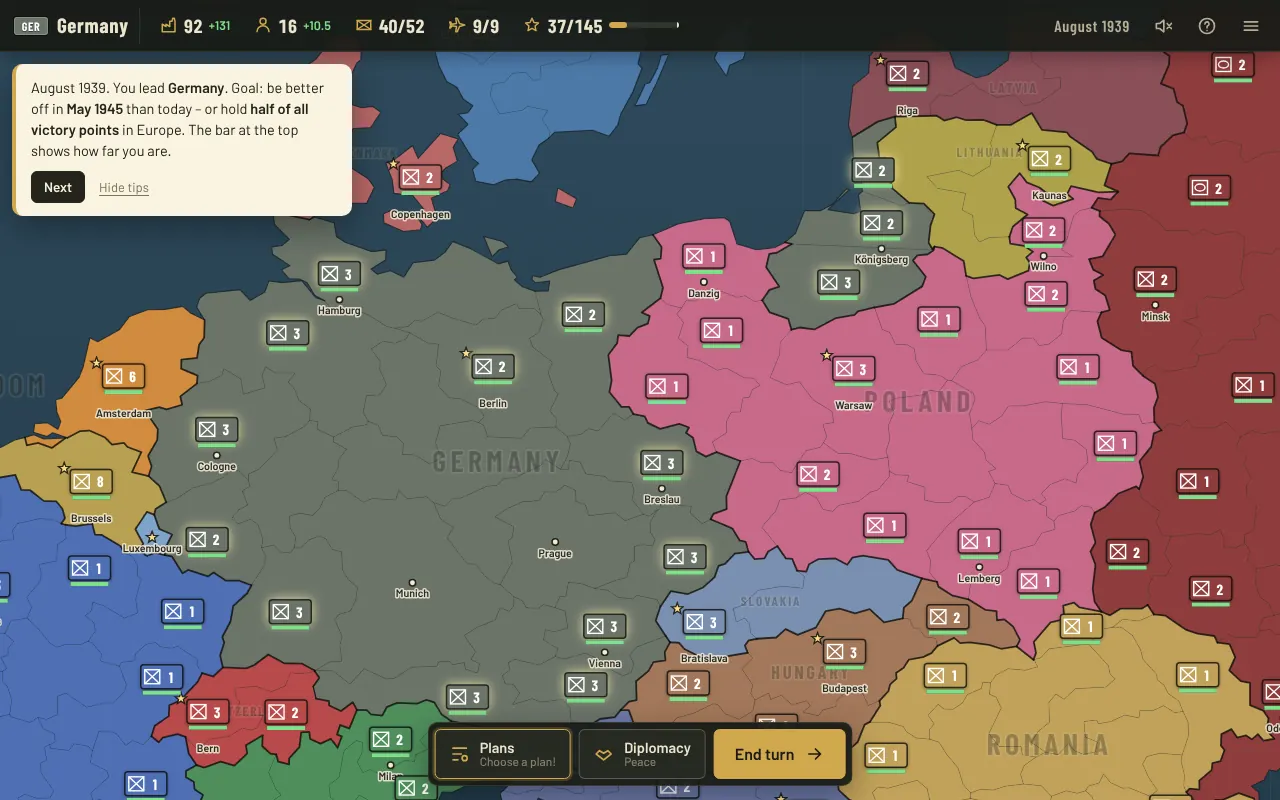
- Move the map: drag with the mouse or one finger. Zoom: mouse wheel or two fingers.
- Select: click a province or one of the boxes with a number – those are armies. The panel on the right (at the bottom on phones) shows what you can do there.
- Move: select one of your armies, then click a green province. Dashed lines are sea routes, for example across the Channel or the Strait of Gibraltar.
- Attack: click a red province next to your army. That opens the battle plan.
- End turn: the big button at the bottom. Then all other nations move. Esc clears the selection.
Turns and economy
One turn is one month. At the end of every turn you get production from your factories and recruits from your provinces. Production pays for everything you build; every new division also needs one recruit. How many divisions you can have at most – the troop limit – grows with your factories and your land.
- Infantry (10 production): cheap and strong in defence. Moves one province per turn.
- Tanks (24 production): hit hard in attack and move two provinces per turn in your own land.
- Air wing (20 production): supports attacks, see below.
- Factory (40 production): +2 production every turn from now on.
- Fort (20 production): each level makes defenders there 25 % stronger, up to three levels.
Troops can only be trained in your own core provinces. Occupied land brings only half its production. New troops can move from the next turn.
Battle plan and combat
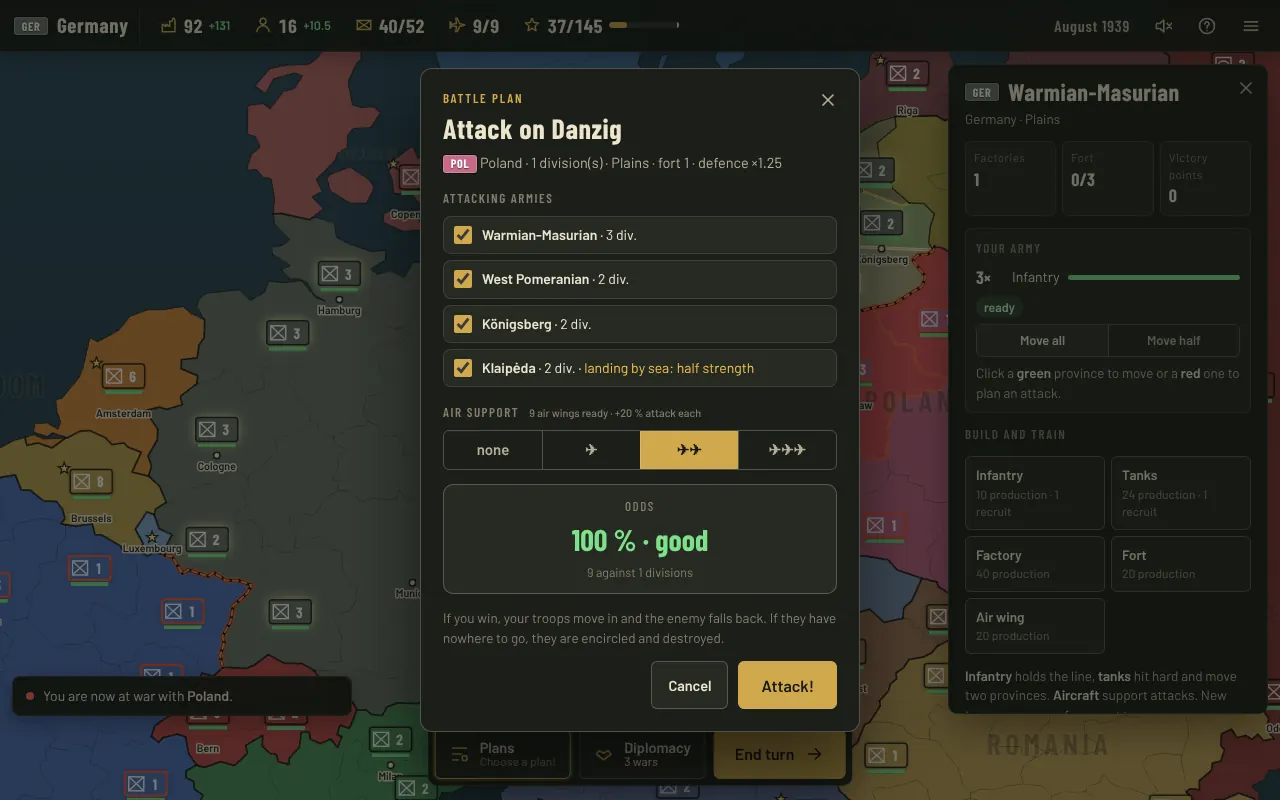
When you click a red province, the battle plan opens. All your armies next to the target with moves left can take part – you choose which ones. Below that you choose how many air wings support the attack. The odds update with every change.
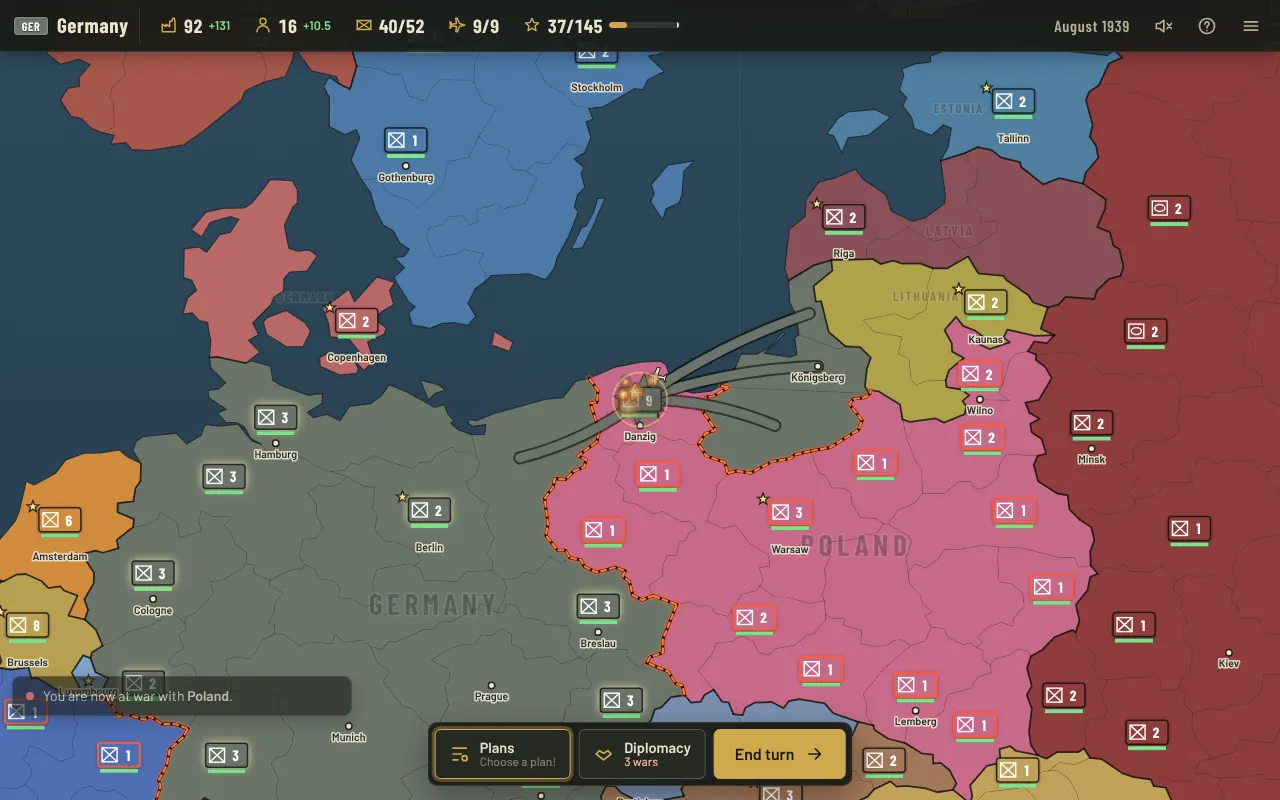
Then the battle runs on the map: attack arrows, aircraft, artillery fire. A banner tells you the result:
- Breakthrough: your troops move in, the defenders fall back to a neighbouring province.
- Encircled: if the defenders have nowhere to go, they are destroyed.
- Attack repelled: your troops stay where they were, weakened.
What decides a battle:
- Terrain: defenders are stronger in forest (×1.2), hills (×1.35) and mountains (×1.6). Plains and desert give no bonus.
- Forts: +25 % per level. A captured province loses one fort level.
- Capital: +15 % for the defender.
- Sea landings: troops attacking across the sea fight at half strength.
- Garrisons: even an empty province in enemy core territory is defended by a small garrison (two in a capital). Occupied land without troops is taken without a fight.
- Air wings: each one gives +20 % attack. Air wings can be shot down, more often if the enemy has many of its own.
Taking a province always ends the move – even for tanks. That way the front moves at most one province per turn, and you have time to react.
Winning, losing and surrender
Cities like Berlin, London, Paris, Rome or Moscow carry victory points. If you hold half of all victory points in Europe, you win at once. Otherwise the game ends in May 1945: if you hold more victory points than in August 1939, you come out of the war stronger.
Every nation surrenders once it has lost enough core territory – what counts most are provinces with victory points. The red Surrender marker at the top shows how close you are; at 100 % you give up. A nation that surrenders hands its remaining land to the enemy that conquered most of it.
Alliances and history
In August 1939 there are three alliances: the Allies (France, Poland, United Kingdom), the Axis (Germany, Italy) and the Comintern (Soviet Union). If someone attacks an alliance member, the others join the war. Under Diplomacy you can see every nation's strength, declare war on neighbours, offer peace and – if you share an enemy or a border – join an alliance.
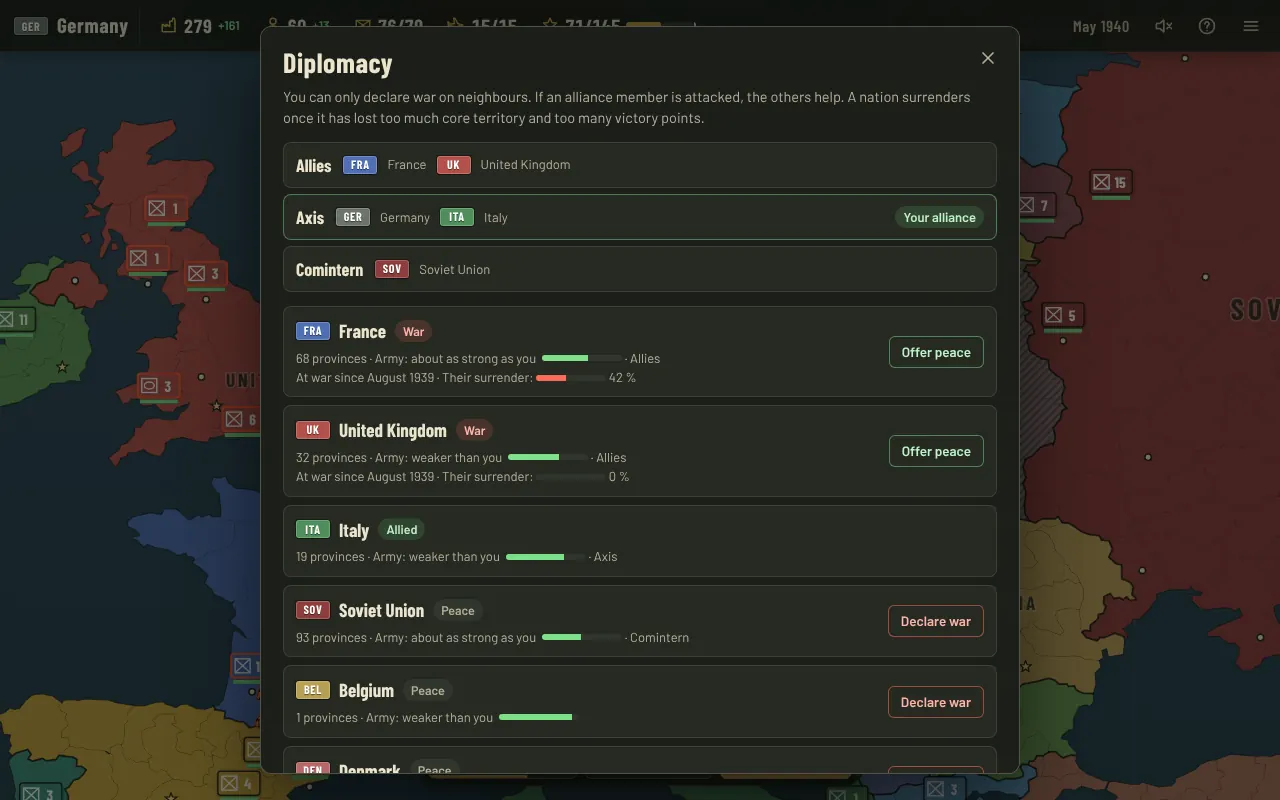
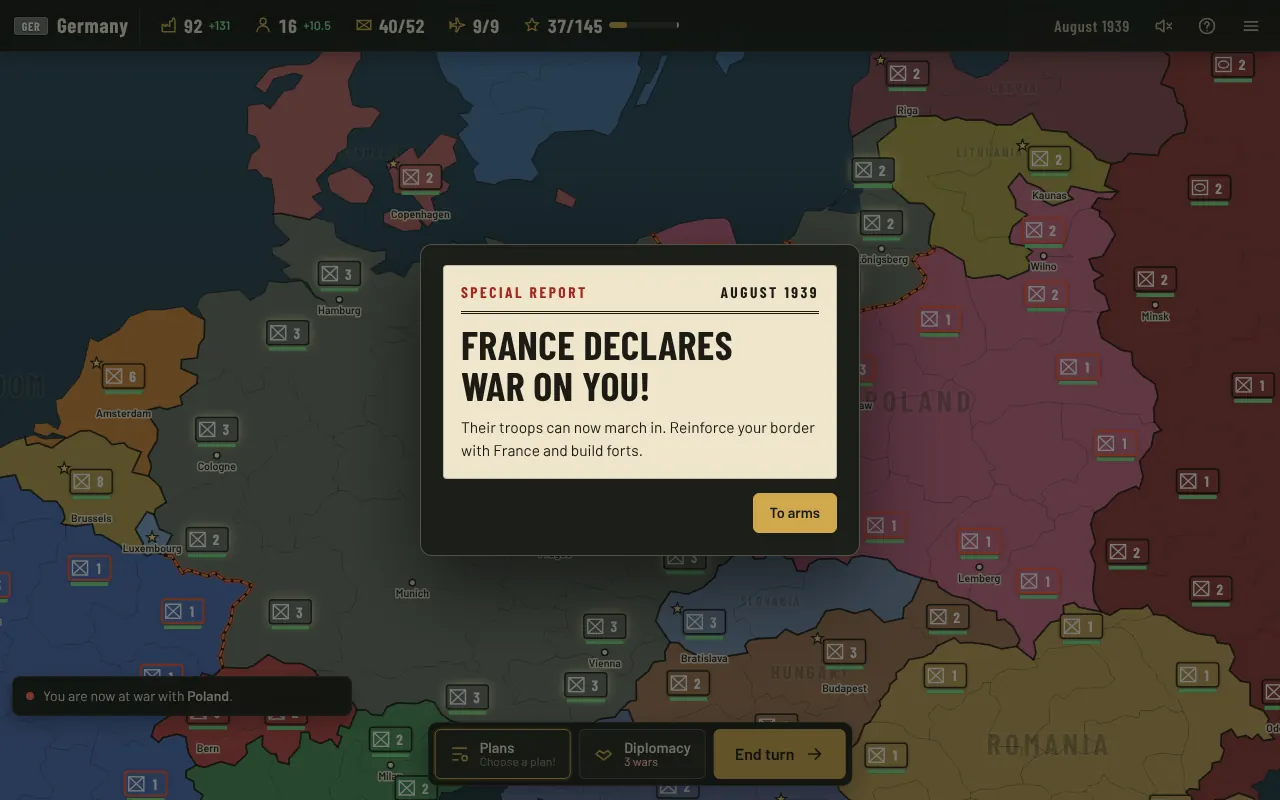
The computer nations roughly follow the course of history from 1939 to 1941: Germany attacks Poland in September 1939, the Soviet Union attacks Finland, the war spreads to Scandinavia, the Low Countries and the Balkans, and in June 1941 Germany turns on the Soviet Union. Big events arrive as special reports. The nation you play only does what you decide – so you can change history.
National plans
Under Plans you choose one national plan at a time. It runs for three to five turns and then gives a permanent bonus. There are three branches with three steps each:
- Industry: expand factories (+1 factory in four provinces), war economy (+25 % production), heavy industry (+1 factory in eight provinces).
- Army: mobilisation (+8 recruits and three infantry divisions), tank doctrine (tanks attack 25 % harder and cost 20 % less), air superiority (+4 air wings, each worth 30 % instead of 20 %).
- Defence: border forts (+1 fort in every border province), defence in depth (+20 % defence), home guard (+2 forts and four infantry divisions in the capital).
Tips for beginners
- Start a plan in the first turn. A plan that runs from August 1939 pays off for the whole war.
- Put your troops on the border. Empty border provinces only have a small garrison.
- Attack together. Two or three armies plus air support win where a single army fails.
- Look for encirclements. If the enemy army has no own province behind it, a win destroys it completely.
- Avoid mountains and forts. Go around strong positions – the odds show you immediately whether it is worth it.
- Keep your capital safe. It counts a lot towards surrender.
- Spend your production. Unused production wins no battles: build factories early, troops when war is near.
Frequently asked questions
Does Warfront cost anything?
No. Warfront is free, without purchases and without an account.
Is the game historically accurate?
The borders, nations and starting alliances follow the situation of August 1939 as closely as a game map allows; provinces are modern regions grouped together. Battles and the course of the war are a game, not a simulation – history can turn out quite differently.
Is my game saved?
Yes, automatically after every turn, in your browser on this device. Continue on the start screen takes you back. If you clear your browser data or use a private window, the save is gone.
Can I play on my phone?
Yes. Drag to move the map, pinch to zoom, tap to select. On a larger screen you see more of the front at once.
Can I play with friends?
Not yet – Warfront is a single-player game against the computer nations.
Behind the scenes
The map is built from Natural Earth, a free public-domain map dataset: the regions of each country were assigned to their owner in August 1939, grouped into provinces and simplified. Battles are decided by a small dice-based model, and the odds you see before an attack come from playing the same battle 160 times in advance. All sounds – artillery, rifle fire, aircraft and fanfares – are synthesised live in your browser. Flags are shown as coloured country codes instead of historical flags.