What is an idle game? Explained with Idle Boxing Gym
Guide · Updated 22 October 2026
Idle games are among the most unusual kinds of games: they keep going when you do nothing. On PP2 Hub, Idle Boxing Gym is one of them. In this article we explain how idle games work, why they are so gripping and how to play them well – using the boxing gym as an example.
The basic idea: click first, then let it grow
At the start of an idle game you do almost everything yourself. In Idle Boxing Gym every click hits the punching bag and earns you training points. With those you buy your first upgrades – and above all, things that keep working without you: a second punching bag, a speed bag, later a ring, a sparring partner and a trainer. From then on your gym grows even when you take your hand off the mouse.
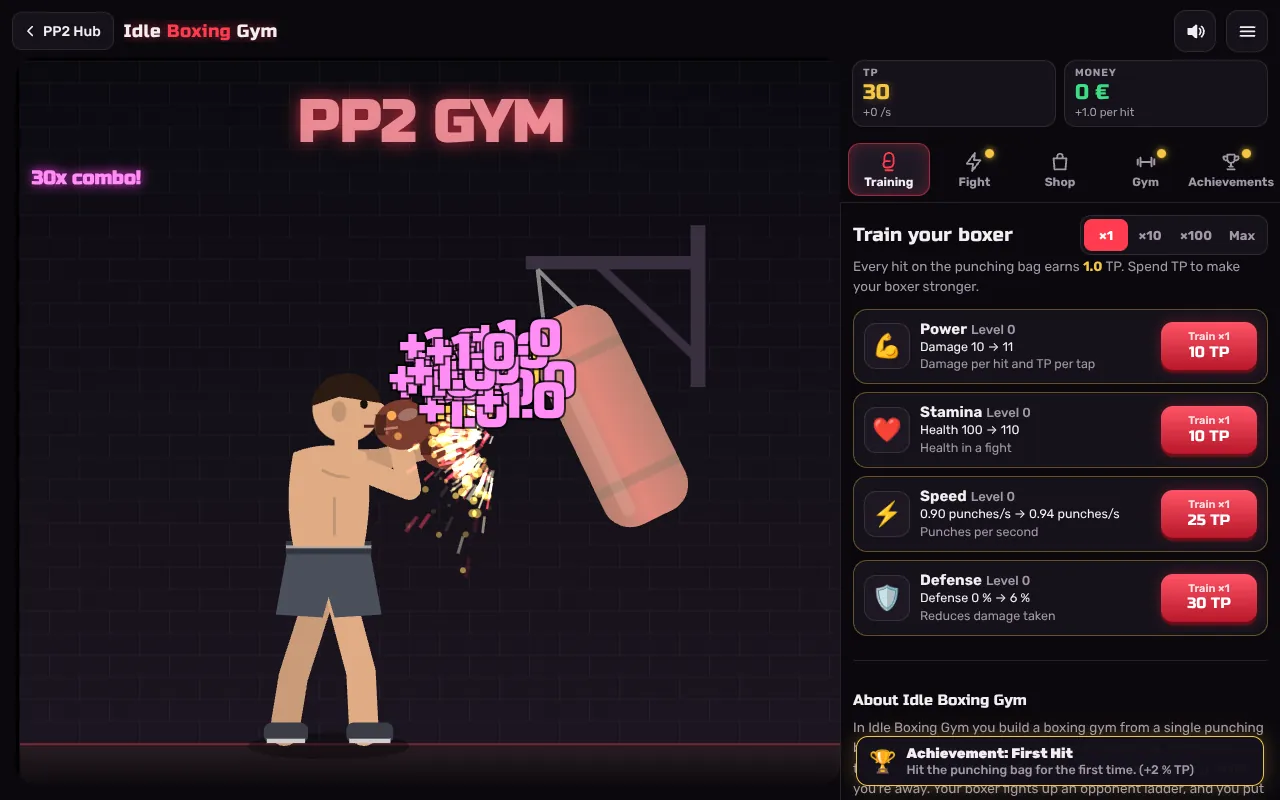
That is the core of the genre: active work gradually turns into passive income, and your job shifts from clicking to deciding – what do I buy next?
Big numbers: exponential growth
Idle games are famous for huge numbers. That comes from a simple rule: each additional unit of a piece of equipment costs a bit more than the last – 15 percent in Idle Boxing Gym. At the same time, an item's output doubles at certain thresholds: 10, 25, 50, 100, 150, 200 and 300 units. So both prices and income grow exponentially, and the game stays in balance.
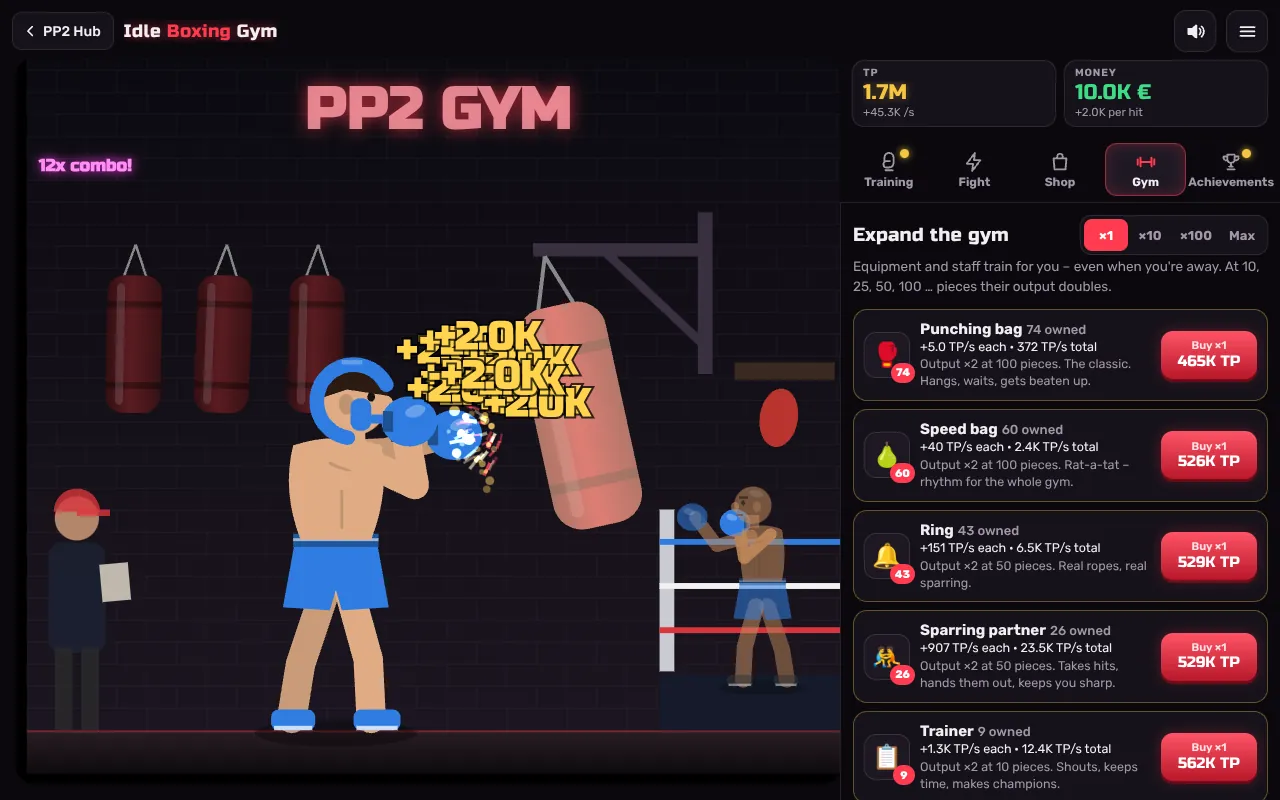
The opponents follow the same pattern: each one on the ladder is a fixed step stronger than the last. By the time you go from the first opponent to the world champion, you're dealing with health many times higher than at the start.
Starting over: prestige
At some point progress slows down. Every next purchase takes longer, and so does every next opponent. This is where the most important tool of almost every idle game comes in: the voluntary restart, often called “prestige”.
In Idle Boxing Gym it's called “ending your career”. You can do it from your win over opponent no. 10. Your boxer and gym then start from scratch – but you receive legend points, depending on how many training points you earned in that career and how many bosses you beat. Each legend point gives a permanent 10 percent more training points and 5 percent more damage and health. That's why the second career runs much faster than the first, and the third faster still.
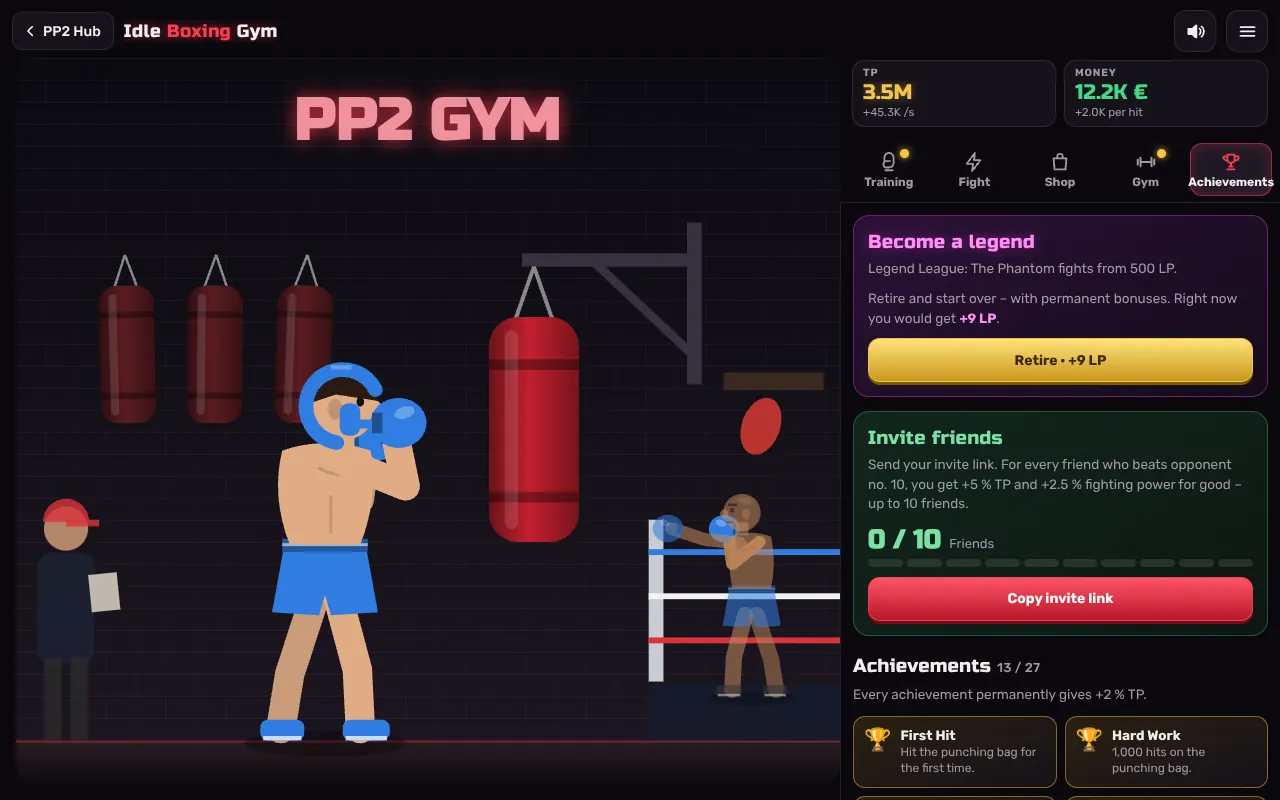
It feels wrong at first – why throw everything away? But this very loop is the engine of the genre: every restart ultimately takes you further than you would have got without it.
Offline progress
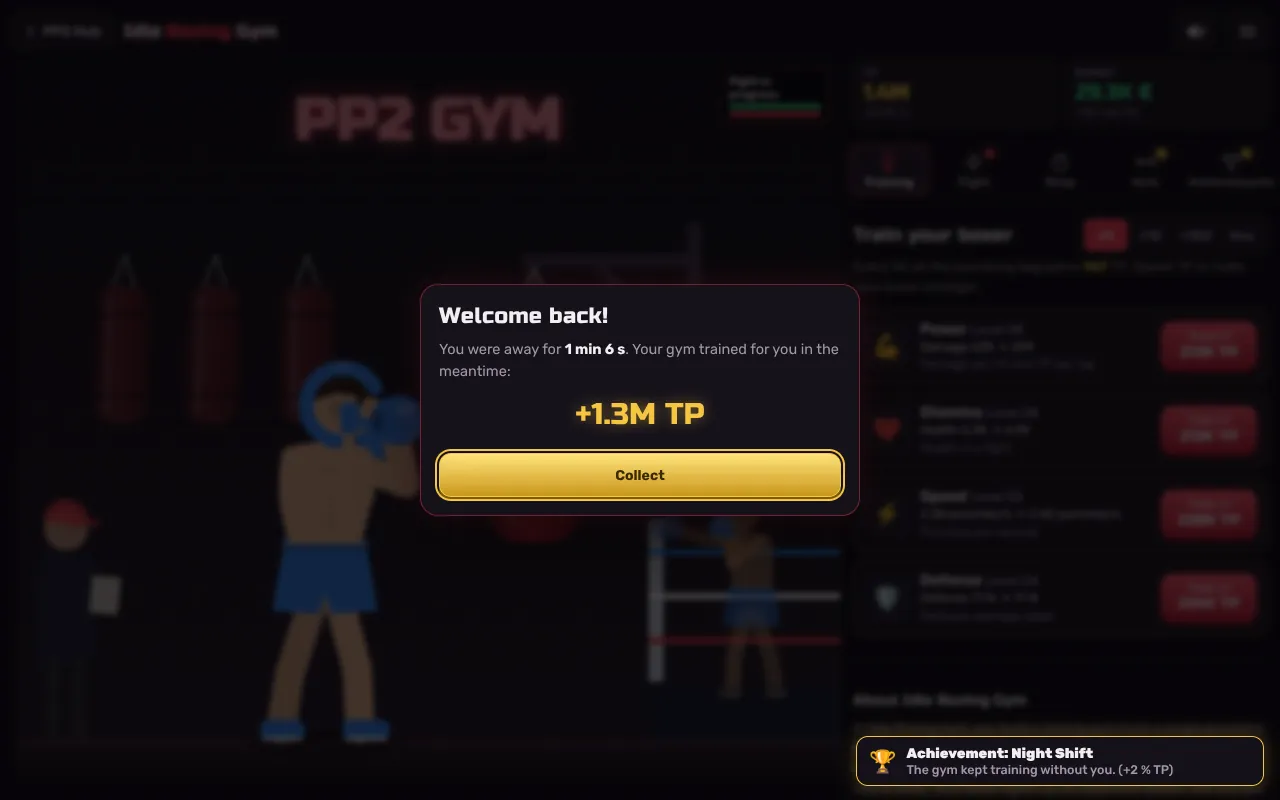
An idle game keeps working even when you close the page. On your next visit, Idle Boxing Gym works out how long you were away and credits you the training points – up to eight hours. If you drop by briefly in the morning and evening, you hardly lose anything.
Strategy: how to play smart
- Buy to thresholds. Instead of spreading your points evenly, it pays to push one item to its next doubling.
- Find the bottleneck. If you lose to an opponent, it's usually one stat: too little damage, too little health or too little defense. Improve the weakest one on purpose.
- Prepare for bosses. Every fifth opponent is a boss with more health and harder punches, but pays triple. A new gear tier before the boss fight often makes the difference.
- Restart early. Many players wait too long for their first restart. Even a few legend points make the next career noticeably faster.
- Collect achievements. In Idle Boxing Gym, each of the 27 achievements gives a permanent 2 percent more training points.
Why idle games are so gripping
Idle games reward you regularly and in small portions: there's almost always something new within reach – an item, a gear tier, an opponent. At the same time they ask for little time at a stretch. That makes them good companions for short breaks. A well-made idle game is about decisions, not endless clicking, though – so it pays to pause now and then and think instead of just tapping.
Playing without paying
Many idle games in app stores make money by shortening waiting times or selling boosts. Idle Boxing Gym has no purchases: everything in the game is earned in the game. Your save stays in your browser, and you don't need an account.